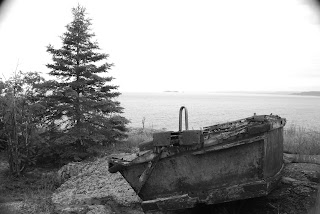
 While hiking in Neys Provincial Park in Canada, Elaine and I ran across some abandoned wooden logging boats. We soon found out these old rotting boats had quite an interesting history.
After the outbreak of WWII, Canada found the need to open several German prisoner of war camps. In all, Canada opened 26 P.O.W. and Japanese internment camps that operated from 1941 to 1946. Three of the largest were along the Lake Superior north shore coast at Angler, Neys and Red Rock. The German prisoners were divided into groups, "Greys" were ordinary enlisted solders and "Blacks" were die-hard Nazis. Neys Camp 100 was housing mainly "black" Nazis. It was more secure with three layers of barbed wire fencing and guard towers. Escape by tunneling was difficult because of the loose sand; however it was attempted. One prisoner carved a set of wooden ice skates to skate away after the lake froze, but the lake didn't freeze enough that winter. Many of the native loggers enlisted or went to work in the factories to support the war effort. The nation still needed lumber, so the prisoners were put to work logging.

 Each prisoner was payed a wage. The logging was done along the Pic River and the Little Pic River. The logs were cut and then floated down the rivers to the lake. Boats were used to transfer the prisoners to and from the work area and to help corral the logs as they floated down the river. After the end of the war the camp became a prisoner distribution center and the prisoners were repatriated with their homeland. Having found their treatment by the Canadians fair and having learned a trade many returned to the region to continue to log and work and raise families.
 These boats were owned by the Pidgeon River Timber Company and were used in the region during the mid 1940's when most of the labor was prisoners. Made of wood with some tin sheathing, you can see they were work boats. Although they are rotting away, numerous repairs and patches are still evident. These boats can be found at Neys Provincial Park in Neys, Ontario, Canada.

 Each prisoner was payed a wage. The logging was done along the Pic River and the Little Pic River. The logs were cut and then floated down the rivers to the lake. Boats were used to transfer the prisoners to and from the work area and to help corral the logs as they floated down the river. After the end of the war the camp became a prisoner distribution center and the prisoners were repatriated with their homeland. Having found their treatment by the Canadians fair and having learned a trade many returned to the region to continue to log and work and raise families.
 These boats were owned by the Pidgeon River Timber Company and were used in the region during the mid 1940's when most of the labor was prisoners. Made of wood with some tin sheathing, you can see they were work boats. Although they are rotting away, numerous repairs and patches are still evident. These boats can be found at Neys Provincial Park in Neys, Ontario, Canada.
 Walk the Point Trail for about 1 Km. to the rocky point above the lake. Bathe in mosquito repellent before you go. The boats are up on the rocks. For more information go to http://www.ontarioparks.com/

 State of Michigan auto ferry
 On December 3, 1987, while being towed to Japan to be scrapped, the Gulf


 H.T. POTT was built in 1933 at St. Louis and was the first all welded hull tow boat. She spent most of her time working around Kansas City, Missouri.